

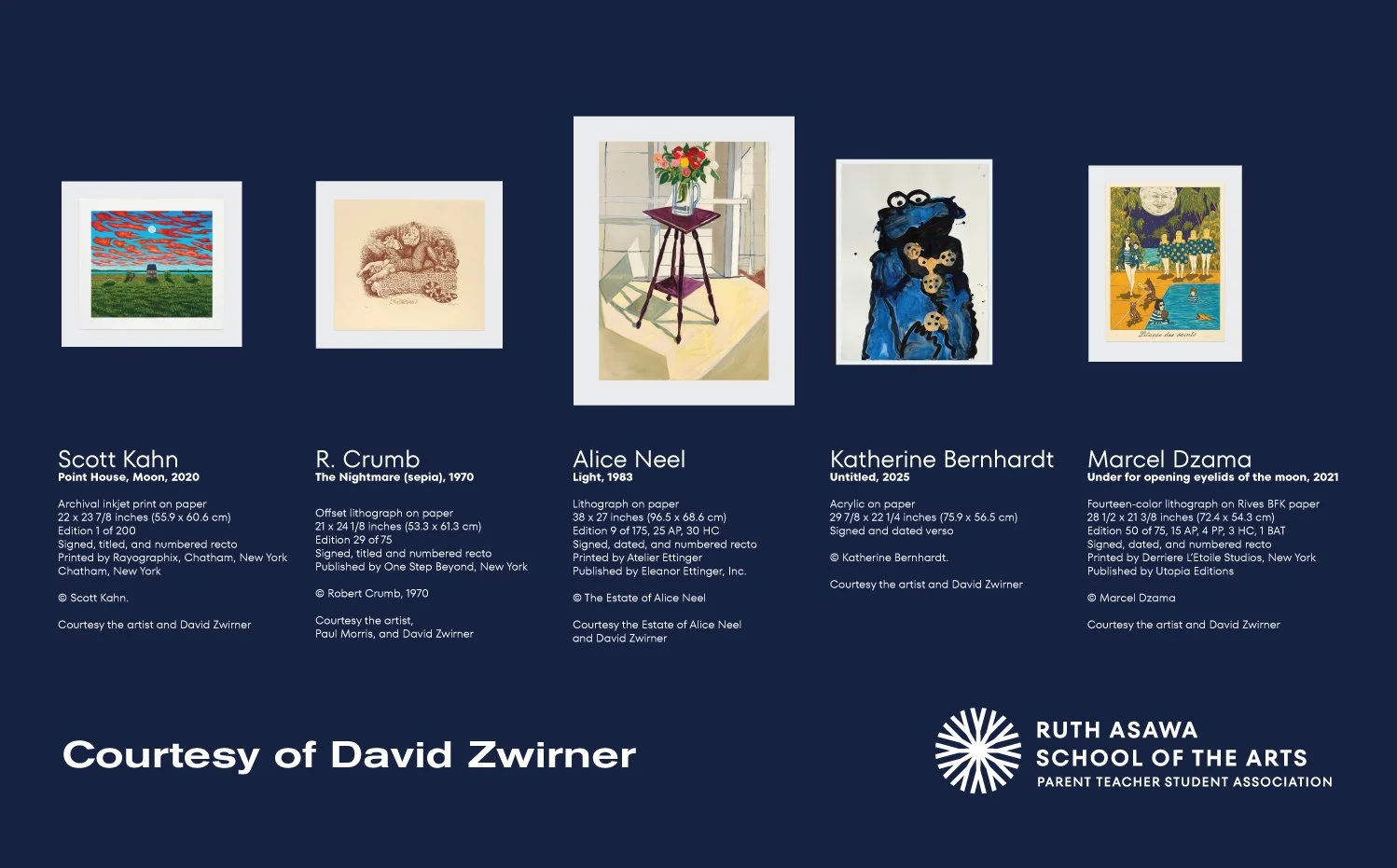
The PTSA is immensely grateful to the contemporary and legacy artists of the internationally renowned David Zwirner Gallery who have contributed major works of art to benefit Ruth Asawa School of the Arts, to honor Ruth Asawa’s passionate advocacy for arts education in San Francisco’s public schools.
Ruth Asawa worked for decades to bring public arts education to school children in San Francisco. Inspired by her arts education at Black Mountain College, she served on the San Francisco Arts Commission, established the Alvarado School Art Workshop, and finally in 1982 achieved her dream of establishing a multi-disciplinary public arts high school in San Francisco.
David Zwirner is a leading contemporary art gallery with locations in New York, Los Angeles, London, Paris, and Hong Kong. Representing more than seventy artists and estates, the gallery is known for presenting innovative, singular, and pioneering exhibitions across a wide range of media and genres. Active in both the primary and secondary markets, David Zwirner has played a key role in shaping the careers of many of today’s most influential artists and has maintained long-term representation of a wide-ranging, international group of artists.
The Estate of Ruth Asawa has been represented by David Zwirner since 2017.
Katherine Bernhardt
Untitled, 2025
Acrylic on paper
29 7/8 x 22 1/4 inches (75.9 x 56.5 cm)
Signed and dated verso
Katherine Bernhardt’s (b. 1975) boundless visual appetite has established her as one of the most energetic painters working today. Having gained prominence in the early 2000s for her spirited depiction of celebrities and models, Bernhardt appropriated much of her imagery at the time from fashion periodicals such as Elle and Vogue. In the decade following, she began making “pattern paintings” that equally reference pop art and the serial repetition in certain modes of postwar painting. Juxtaposing an ever-expanding list of quotidian motifs—tacos, coffee makers, toilet paper, cigarettes, E.T., Garfield, Darth Vader, and the Pink Panther—these works feature unlikely combinations within flat, expansive fields of exuberant color.
The compositional elements of Bernhardt’s paintings include palettes that allude to the tropical climes of Puerto Rico, references to the design and coloration of Moroccan rugs and West African Dutch wax fabrics, and influences ranging from Henri Matisse and the Pattern and Decoration movement to Peter Doig and Chris Ofili. Bernhardt’s process is improvisational and loose, and her practice invites accident and chance into the compositions. To create her works, she first draws on upright canvases with spray paint, after which she lays them on the floor to apply acrylic paint thinned out with water. The writer Nicole Rudick observes, “Speed is essential to her process. Artmaking, for Bernhardt, shouldn’t be tedious, but raw, messy, and fast….When she produces paintings in a series, she lays four or five canvases on the floor and works on them simultaneously, jumping back and forth among them, spontaneously applying the same motifs and colors to multiple canvases…” ¹
The present drawing relates to a body of work in which the artist fills the wide-open maw of the Sesame Street character Cookie Monster with various motifs—here, his beloved cookies. In this series of images, she pays winking art-historical homage to the fifteenth-century Bolognini Chapel fresco by Italian Renaissance painter Giovanni da Modena, known as the Inferno (c. 1410), in which a similarly blue-haired beast devours and excretes a screaming human being while surrounded by a swirling host of shocking events. Here, Bernhardt reimagines the hellmouth as a joyful landscape for a kind of new pattern painting that jumbles together a plethora of items.
For her works on paper, Bernhardt draws first and then applies layers of colorful acrylic paint thinned with water, which pool and run together on the surface. Here, a pale blue mushroom takes a shower in a white-tiled stall lined with black grout. The work is mounted in a custom frame applied with a pink paint that Bernhardt chose to complement the composition.
¹ Nicole Rudick, Katherine Bernhardt (New York: CANADA, 2017), p. 165.
© Katherine Bernhardt. Courtesy the artist and David Zwirner
Alice Neel
Light, 1983
Lithograph on paper
38 x 27 inches (96.5 x 68.6 cm)
Edition 9 of 175, 25 AP, 30 HC
Signed, dated, and numbered recto
Printed by Atelier Ettinger
Published by Eleanor Ettinger, Inc.
Alice Neel (1900–1984) is widely regarded as one of the foremost American artists of the twentieth century. As the avant-garde of the 1940s and 1950s renounced figuration, she developed her signature approach to the human body. Working from life and memory, Neel painted writers, poets, artists, activists, family, friends, and others around her with unfazed accuracy, honesty, and compassion.
Her paintings, which are forthright, intimate, and, at times, humorous, engage overtly and quietly with political and social issues. Calling herself a “collector of souls,” Neel is acclaimed for not only capturing the truth of the individual, but also reflecting the era in which she lived.
© The Estate of Alice Neel
Courtesy the Estate of Alice Neel and David Zwirner
R. Crumb
The Nightmare (sepia), 1970
Offset lithograph on paper
21 x 24 1/8 inches (53.3 x 61.3 cm)
Edition 29 of 75
Signed, titled and numbered recto
Published by One Step Beyond, New York
Instrumental in the formation of the underground comics scene in the 1960s and 1970s, R. Crumb (b. 1943) has helped challenge and expand the boundaries of the graphic arts and redefined comics and cartoons as countercultural art forms. Widely circulated, often celebrated, Crumb’s published imagery, such as his comic strips Fritz the Cat, Mr. Natural, and Keep on Truckin’, offers a mordant satirical critique of modern society, directly addressing political disillusionment, the never-ending battles between “squares” and bohemians, racial and gender stereotypes, sexual fantasies and fetishes, and the absurdities of social convention and conformity—themes the artist also often explores through disturbing but hilariously abject self-caricature that dramatizes incidents in his own life and surroundings.
The present lithograph was published by One Step Beyond in New York. The imagery relates to a drawing by Crumb that reimagines The Nightmare (1781) by Henry Fuseli in his signature satirical style. Here, Crumb renders the slumbering female figure of Fuseli’s painting in characteristically exaggerated fashion, while the incubus looming over her is replaced by the Snoid, one of Crumb’s best-known characters, who is often portrayed as an impertinent sexual deviant.
© Robert Crumb, 1970
Courtesy the artist, Paul Morris, and David Zwirner
Scott Kahn
Point House, Moon, 2020
Archival inkjet print on paper
22 x 23 7/8 inches (55.9 x 60.6 cm)
Edition 1 of 200
Signed, titled, and numbered recto
Printed by Rayographix, Chatham, New York
Rooted in his everyday life and experiences, American artist Scott Kahn’s (b. 1946) enigmatic landscapes, portraits, and dreamscapes blend real and surreal elements. The artist has remained committed to a figurative mode of expression over the course of more than five decades, using a distinctive formal language to achieve a nuanced and poetic rendition of the simultaneous splendor and mundanity of the world around him. His surfaces are meticulously constructed according to precise geometries and chromatic and spatial relationships, wherein the artist employs perspective and light to establish an illusory sense of depth that underscores the resonances imparted by the recurring cast of people, places, and symbols. Kahn’s works evidence his individual point of view while opening out onto universal themes, offering viewers a conduit through which to access a wide range of emotions.
The moon appears throughout Kahn’s body of work, frequently in the background of his paintings as a sort of omen for the scene laid out beneath. Point House, Moon belongs to a group of works that focus on the full moon, with its myriad connotations, as the central compositional element. Occurring twelve (or occasionally thirteen) times per year, each full moon is laden with its own meaning specific to the month in which it takes place.
© Scott Kahn. Courtesy the artist and David Zwirner
Marcel Dzama
Under for opening eyelids of the moon, 2021
Fourteen-color lithograph on Rives BFK paper
28 1/2 x 21 3/8 inches (72.4 x 54.3 cm)
Edition 50 of 75, 15 AP, 4 PP, 3 HC, 1 BAT
Signed, dated, and numbered recto
Printed by Derriere L’Etoile Studios, New York
Published by Utopia Editions
Since rising to prominence in the late 1990s, Canadian-born artist Marcel Dzama (b. 1974) has developed an immediately recognizable visual language that investigates human action and motivation, as well as the blurred relationship between the real and the subconscious. Drawing equally from folk vernacular as from art historical and contemporary influences, Dzama’s work visualizes a universe of childhood fantasies and otherworldly fairy tales.
The present print is from a group of works that expand on Dzama’s interest in travel and nature, two themes that have become increasingly prevalent in his art. Many of these works were initially inspired by photographs Dzama took in Morocco, Mexico, and Fire Island, New York, places he traveled before the 2020 COVID-19 pandemic. Dzama incorporates elements of the photographs into the world of his art, resulting in works that mix tropical imagery, depictions of leisure and play, and bright colors with illustrations of masked and mysterious characters, as well as dancers, wild animals, and hybrid figures inspired by mythic, biblical, and literary subjects.
For Dzama, these fantastical compositions of familiar yet far-off, enchanted worlds respond, in part, to the universal experience of isolation during the pandemic, and a sense of wanderlust that many experienced while in lockdown. “I find the fear, anxiety, and sadness from the virus has changed my art,” Dzama notes. “It has focused it in a more hopeful and positive direction. I find when things are more easygoing, I get a little more cynical and world-weary, but when things are down, I find myself being more hopeful and positive in my work.”¹
This lithograph, which relates to a 2021 drawing by the artist, was directly inspired by Dzama’s travels immediately before the start of the COVID-19 pandemic. The figures in Picabia-esque polka-dotted attire represent the virus looming in the distance. Their masks, which are inspired, in part, by the costumes in Oskar Schlemmer’s iconic Triadic Ballet(1922), are similar to those appearing in numerous other works by the artist. Dzama has also included a portrait of his friend Spike Jonze’s chihuahua. The anthropomorphized moon in this work directly recalls the moon in French filmmaker Georges Méliès’s seminal early film A Trip to the Moon (1902), while also alluding to the rare convergence of lunar events in 2020 and 2021, including a so-called super blood moon and a blue moon.
¹ Marcel Dzama, quoted in Barry Samaha, “State of the Art Industry in the Time of Coronavirus,” Harper’s Bazaar (May 7, 2020), accessed online.
© Marcel Dzama / Courtesy the artist and David Zwirner